Death by Dentition: The Grimy Reality of Human Bites in the 19th Century
In historical romance, death most often arrives by sword, pistol, or a tragic fall from a horse. Yet for the villain who lacks honour, there existed a far more ignoble—and historically accurate—end: death by a human bite.
To modern sensibilities, the idea that a bite from another person could prove fatal may sound implausible, even melodramatic. In the early nineteenth century, however, it was a grimly credible outcome. Before antibiotics and antiseptic practice, a human bite was not merely dangerous—it was often a death sentence, leading to a slow and agonising decline commonly described at the time as “blood poisoning.”
Contrary to modern assumptions, the human mouth was well known to physicians of the period as a source of grave infection. The English surgeon John Hunter, writing in the late eighteenth century, observed that wounds contaminated by bodily fluids were especially prone to dangerous inflammation. Though he did not single out human bites specifically, his conclusions align with what later medicine would confirm: the mouth harbours a particularly noxious array of organisms.
The danger lay not only in the bite itself, but in how deceptively minor such injuries often appeared. Teeth frequently caused small punctures or ragged tears—injuries easily dismissed in an age when serious harm was associated with obvious trauma. A bitten hand might be wrapped in a handkerchief, numbed with brandy, and ignored.
Medical accounts from the period are filled with patients who initially “appeared in good spirits” after minor wounds, only to worsen dramatically days later. Percivall Pott, whose writings on inflammation and gangrene were widely read, warned that the outward appearance of a wound was a poor guide to its true danger. Nowhere was this truer than with injuries inflicted by teeth.
By 1812, physicians did not know the names of the bacteria involved—Eikenella corrodens or Staphylococcus aureus—but they understood the consequences. Wounds caused by teeth were notorious for “mortification,” a term encompassing infection, tissue death, and systemic illness.
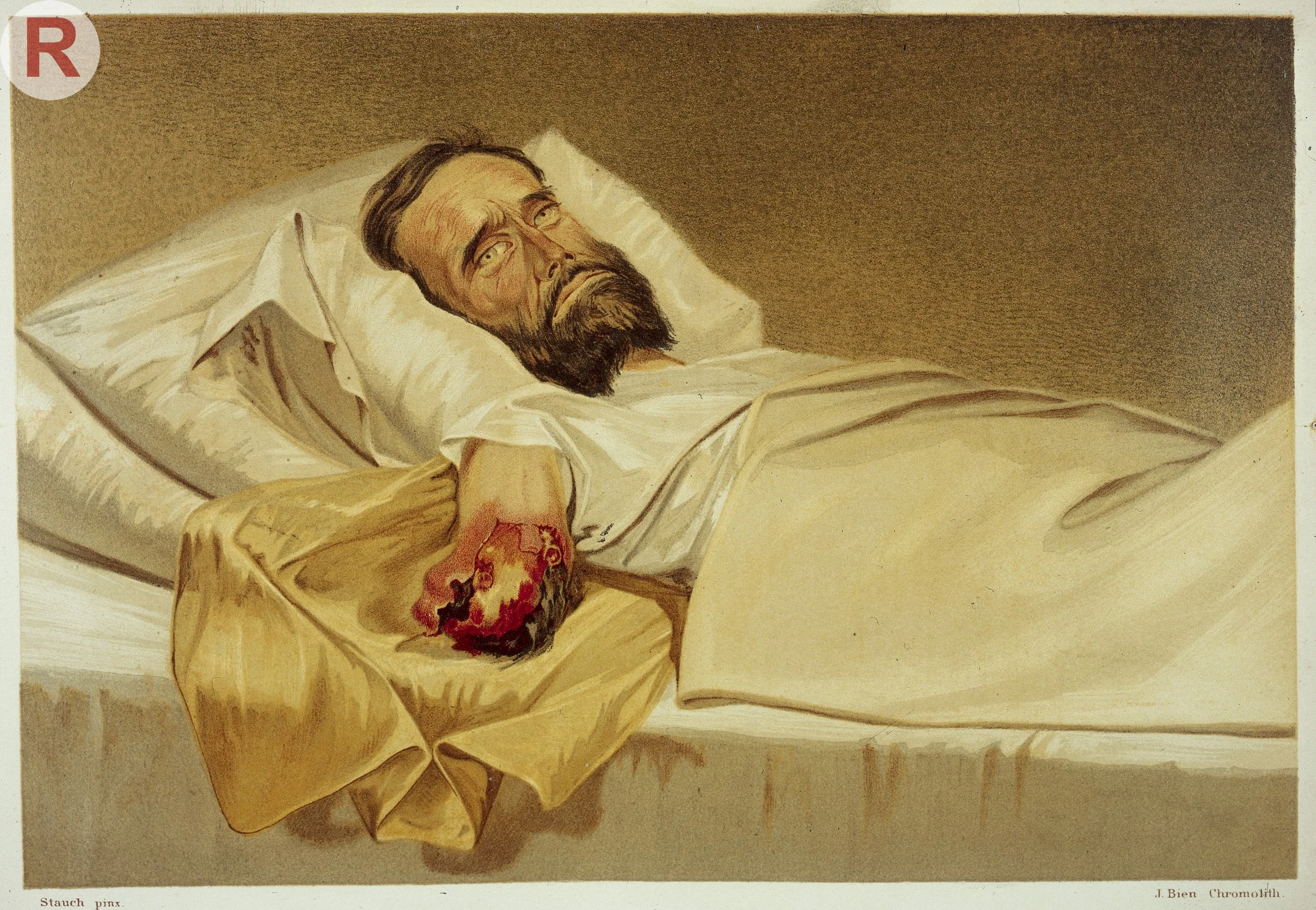
Such an infection followed a cruelly predictable course. At first, the wound appeared insignificant. Then swelling set in, the skin tightening and shining with inflammation. A surgeon might apply a poultice of bread and milk or linseed, intending to soothe the injury. In reality, the warmth and moisture often hastened decay.
Soon, the wound would begin to discharge foul-smelling matter. Surgeons sometimes hoped for “laudable pus,” believing it a sign of healing, but in these cases it marked the advance of infection. Red streaks might appear along the limb, signalling the spread of poison through the body. The flesh around the wound darkened from grey to black as blood supply failed. This was wet gangrene, unmistakable in both appearance and odour.
Desperate measures followed. The wound might be lanced or cauterised. Bleeding or cupping might be employed to “reduce inflammation,” weakening the patient further. None addressed the true cause.
As infection entered the bloodstream, fever gave way to violent chills and delirium. The body swelled with retained fluid, the complexion took on a grey-yellow cast, and the patient wasted rapidly. Death usually came by collapse of the circulation and failure of the organs—what modern medicine recognises as septic shock.
In a world without penicillin, teeth could be as deadly as a loaded pistol. They simply took longer to do their work.